Cheryl
Bird BoxCheryl is a member of the Shillingham house community whose work sustains its everyday defenses against the unseen creatures. Reserved when Malorie first arrives, she becomes a practical caretaker: preparing food, listening for danger, feeding the warning birds, and helping Malorie through labor. Her role shows how survival in the house depends not only on its rules and supplies, but on people quietly performing the tasks that keep those systems working.
Identity and Introduction
Cheryl introduces herself to Malorie by extending a hand. Her welcome is less open than Tom’s or Felix’s: brown hair partly hides her face, and she looks as if she has been working. The brief first impression establishes a guarded presence, though she soon takes part in the household’s care for its newest arrival. She walks Malorie to the couch, where Malorie sits exhausted by shock and grief, and joins Don in preparing food.
The house’s domestic life is already organized around scarcity and precaution. Its windows are covered, its water comes from a well, and its residents must perform even routine chores blindfolded. Cheryl’s role develops within that shared system rather than apart from it: care means both welcoming people and maintaining procedures that reduce the danger of ordinary movement.
Work and Everyday Survival
When Felix goes to the well, Cheryl waits inside the kitchen behind the closed back door. She is the household’s safety net in case something goes wrong outside, listening from a protected position while Felix handles the bucket and rope. The arrangement makes her caution active rather than passive: she does not accompany him, but remains ready to respond if the well trip turns dangerous. When Felix returns in alarm, the back door opens and the household converges around him; amid everyone talking at once, Cheryl asks what happened as Tom orders the others to close their eyes.
The well is essential to the community, but its danger cannot be assessed by sight. Felix’s wooden bucket is the one that fits the hooks above the well, and he follows a path marked with pieces of old picture frames while tethered by a rope. Cheryl’s listening post is the human counterpart to those improvised safeguards. Her assigned vigilance helps make it possible for one person to fetch water while another remains positioned to help, even though neither can see what may be outside.
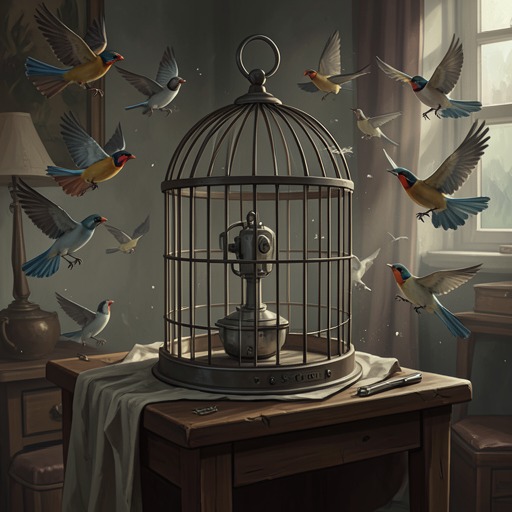
Cheryl also becomes the regular keeper of the birds. Blindfolded, she feels along the house wall toward the box where they are kept, carrying apple slices taken from a can in the cellar. The bricks and then a section of wood paneling guide her hand to the metal hook. She has volunteered for the task and performs it every day. She speaks to the birds about small events inside the house, and their cooing both reassures her and helps her judge how close she is to the box. The routine turns sound into information: the birds’ calls locate Cheryl, while any sound beyond their familiar coos may signal a new threat.
Risk, Judgment, and Community
The community’s cautious routines do not settle its arguments about whether anyone should venture outside. When Tom proposes searching nearby streets for dogs that might serve as an alarm system, Cheryl warns that a three-mile walk carries a much greater chance of encountering a creature than a search within a two-block circle. She also emphasizes that no one knows how animals respond to the creatures, asking what might happen if the huskies saw something. Her concern is not simply that Tom and Jules could be attacked; it is that the group is making a plan without knowing whether the animals meant to protect them would themselves become dangerous.
That skepticism belongs to a wider strain of anxiety. Don argues that another group should prepare to leave if Tom and Jules fail to return, while the people who remain face uncertainty over food and safety. Malorie counters the growing panic by assigning useful tasks around the house, including feeding the birds and making phone calls. The episode sets Cheryl’s warning against a different form of care: she urges the community to reckon with risk, while Malorie tries to keep fear from immobilizing it.
Cheryl participates in decisions about who may share the household’s limited resources. When the community considers whether to admit a newcomer, she answers no; her refusal contributes to a tie that leaves Tom to ask what the group should do next. Later, as Gary’s place in the house becomes a matter of confrontation, Cheryl says without hesitation that he has to go. These choices show her willingness to draw a boundary when she judges the household’s safety or cohesion to be at stake. The evidence does not make her reasoning elaborate, but her answers are direct at precisely the moments when the group must turn uncertainty into a decision.
Care and the Limits of Safety
During Malorie’s difficult labor, Cheryl moves from household vigilance to immediate personal support. She appears beside Malorie and tells her to squeeze her hand, adding that Malorie can break it if she needs to. Malorie is unable to ask aloud for light or a doctor and answers with a grunt. Cheryl offers the one form of help she can provide in that moment: a hand to hold and permission to use it without restraint. Against the house’s larger routines of buckets, blindfolds, and barriers, the gesture is direct and bodily.
Cheryl’s care sits within a community that has already learned the cost of failed defenses. At Tucker, Rick explains that an earlier creature breach led to deaths and to a mother killing four children; the survivors responded by blinding themselves, later easing that burden only after fortifying the facility. Cheryl has no scars. The contrast places her among those who did not undergo that earlier collective self-blinding, without establishing why or what her individual history was. Her work in the house nevertheless belongs to the same continuing problem: protection depends on systems, and every system remains vulnerable to what its users cannot see.
Narrative Role
Cheryl’s significance lies in the connection she makes between community survival and uncelebrated labor. She waits behind a door while Felix fetches water, feeds birds whose calls help orient a blindfolded household, speaks against a dangerous expedition, casts votes on who should remain, and steadies Malorie through childbirth. These actions occupy different scales—from communal policy to a hand squeezed in pain—but all answer the same predicament: how to maintain life when sight cannot be trusted.
The birds make that predicament especially clear. They are companions in Cheryl’s daily routine, and their calls calm her, but the household also relies on them as an alarm. Cheryl’s attachment does not erase their practical function, nor does their usefulness make the task impersonal. Her daily conversations and careful feeding give the warning system a domestic texture: survival is built not from a single heroic defense, but from repeated acts of attention. At the end of the journey, Rick describes the animals and food production available at Tucker, including chickens, a cow, and goats. That prospect of a more secure community contrasts with Cheryl’s precarious routines at the house, where every small task must be performed under the pressure of an unseen threat.